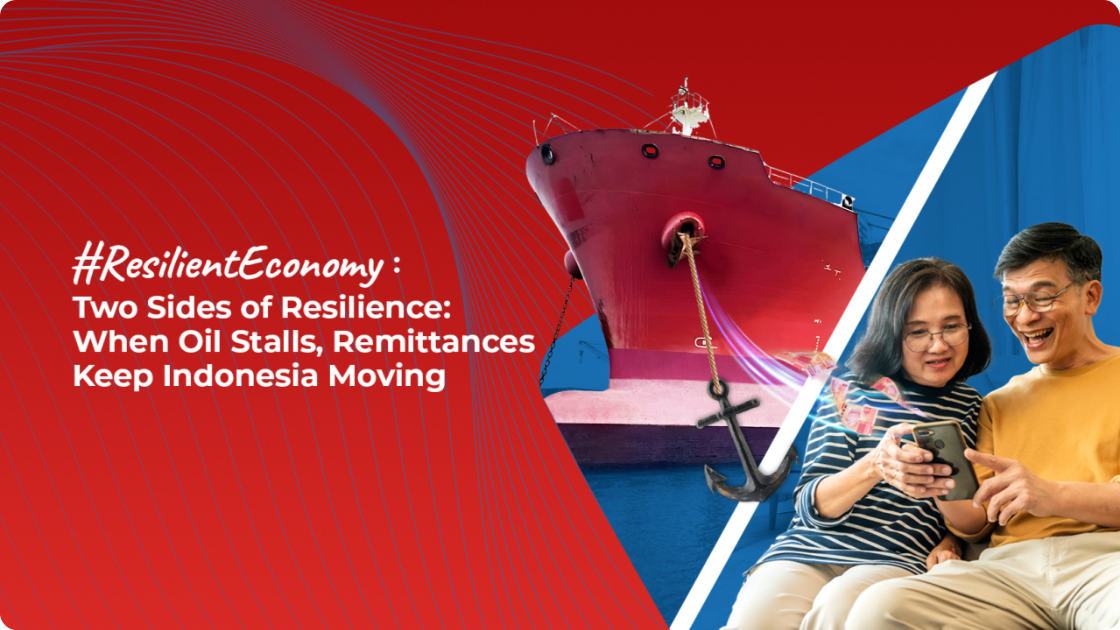
Indonesian Migrant Workers’ Remittances Amid Global Geopolitics: Stable or at Risk?
Behind every remittance sent by Indonesian Migrant Workers (PMI), there are millions of families relying on those funds for their daily lives. From basic necessities and children’s education to housing payments and future savings, many households depend heavily on income earned abroad.
However, amid rising global geopolitical tensions, the stability of remittance flows is facing new challenges.
The Russia–Ukraine war, conflicts in the Middle East, rising global oil prices, and slowing economic growth are not only affecting international markets they are also having a direct impact on the income received by migrant workers’ families in Indonesia. (https://beyondtech.co.id/id)
Remittances: A Key Pillar of Indonesia’s Economy
According to official data from Bank Indonesia and the World Bank, Indonesia receives approximately:
Meanwhile, data from BP2MI (Indonesian Migrant Workers Protection Agency) shows that more than 5 million Indonesian migrant workers are employed overseas, particularly in:
Malaysia
Hong Kong
Taiwan
Singapore
Saudi Arabia
South Korea
For many families in regions such as East Java, West Nusa Tenggara, and Central Java, remittances are the primary source of household income. (https://beyondtech.co.id/id)
How Geopolitics Impacts Migrant Workers’ Income
1. Global Conflicts Pressure Economies in Host Countries
When geopolitical conflicts intensify, many economies experience slower growth.
For example:
The Russia–Ukraine war triggered spikes in energy prices and global inflation.
The IMF reported that global economic growth slowed from 6.3% in 2021 to around 3% in subsequent years due to geopolitical pressures and inflation.
As economies weaken:
companies reduce production,
construction projects slow down,
and labor demand declines.
This directly affects migrant workers through:
As a result, the amount of money sent home to families in Indonesia decreases. (https://beyondtech.co.id/id)
2. Rising Oil Prices Increase Migrant Workers’ Living Costs
Conflicts in the Middle East often drive global oil prices higher.
According to reports from Reuters and the World Bank, geopolitical tensions in the region have pushed global energy prices up by more than 20% during certain periods.
For migrant workers, this means:
Even if wages remain unchanged, the amount of money available to send home becomes smaller. (https://beyondtech.co.id/id)
3. Currency Volatility Creates Income Uncertainty
Global geopolitical tensions also affect currency exchange rates.
For example:
When the US dollar strengthens during periods of uncertainty, many Asian currencies come under pressure.
Fluctuations in the Indonesian rupiah impact the value of remittances received by families.
For migrant workers’ families, this creates challenges such as:
unstable household income,
difficulty in financial planning,
and reduced purchasing power.
The Real Impact on Families in Indonesia
When remittances are disrupted, the effects are immediately felt at home.
Studies on labor migration show that remittances are primarily used for:
household consumption,
children’s education,
healthcare,
and debt repayment.
When remittance flows decline, families may struggle with:
daily living expenses,
school fees,
loan installments,
and savings.
In some migrant-worker-dependent regions, slower remittance flows can even affect local economic activity as community spending declines. (https://beyondtech.co.id/id)
Why Stable Remittance Systems Matter
In times of global uncertainty, remittance systems that are:
fast,
secure,
transparent,
and efficient
become increasingly important for migrant workers and their families.
Delayed transfers or high transaction fees can place even greater pressure on household finances.
This is why digital transformation in remittance services has become increasingly relevant. (https://beyondtech.co.id/id)
The Role of Financial Technology in Supporting Migrant Workers
Digital remittance platforms help migrant workers send money across borders with:
In this context, Beyondtech provides digital remittance solutions that make cross-border money transfers safer, more practical, and more efficient through an integrated payment system. (https://beyondtech.co.id/id)
Conclusion
Global geopolitics has a real and direct impact on the lives of Indonesian migrant workers’ families.
International conflicts, rising energy prices, inflation, and currency volatility can affect migrant workers’ earnings and the remittances received by families back home. (https://beyondtech.co.id/id)
With Indonesia receiving around USD 14 billion in remittances annually, maintaining stable and efficient money transfer systems is essential for supporting the economic resilience of millions of Indonesian families.
In an increasingly uncertain world, fast and transparent digital payment technology can help migrant workers stay financially connected to their families without unnecessary barriers. (https://beyondtech.co.id/id)